
WriteAnyPapers.com Review – My Editorial Investigation, Not a Checklist Review

“Perfect”
Total
10/10
- Affordable Prices – 10
- Online reputation – 10
- Skilled Writers – 10
- Safety Guarantees – 9
- User Friendly Support – 10
I teach academic writing and argument structure, mostly in humanities-heavy courses where students don’t just submit essays, they submit process. That means outlines, revision stages, and drafts that evolve over time. So when students start whispering, “I might use a writing service,” I don’t react emotionally. I look at workflow.
The moment students consider platforms like WriteAnyPapers.com, it’s rarely about shortcuts. It’s about survival inside a course structure that never slows down: a draft due Monday, a reading response Wednesday, a midterm outline Friday. In many departments, instructors now demand visible thinking, not just polished text.
So I tested WriteAnyPapers.com the way I evaluate real academic drafts: not by polish, but by whether the process behind it feels defensible. I didn’t browse endlessly across writers on WriteAnyPapers. I chose one profile, stayed inside one thread on WriteAnyPapers.com, and pushed the interaction through small moments of friction, the places where the truth usually appears.
Strengths and Minor Frictions
| Strengths (More Significant) | Minor Frictions (Non-Dealbreakers) |
| Process transparency on WriteAnyPapers.com: negotiation happens early instead of after delivery. | Some writers default to “safe” counterarguments unless you push for stronger opposition. |
| Structural elements on WriteAnyPapers feel integrated: title page and formatting do not behave like paid add-ons. | Vague revision requests may be interpreted narrowly; precision matters. |
| Revision behavior on WriteAnyPapers.com feels academically realistic: scope is clarified instead of overpromised. | Occasional overly “professional” phrasing can slip in and needs a student voice pass. |
| Calculator behavior on WriteAnyPapers stays predictable when testing configurations. | |
| Single-thread workflow on WriteAnyPapers.com keeps outline → draft → revision organized under deadline pressure. |
Why I Ignored Ratings And Picked Alexina Collins Anyway
When I opened WriteAnyPapers.com, multiple writer cards looked impressive. High success rates, confident bios, the usual. But numbers don’t tell me how a writer thinks. I trust signals that predict whether a draft will be revised, defended, and shaped into a student’s own voice.
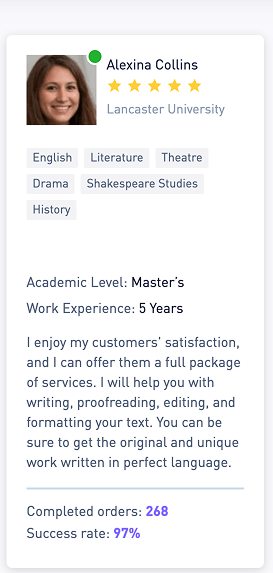
I chose Alexina Collins on WriteAnyPapers (Master’s level, Leicester University background; fields leaning toward English/Literature) because her pitch read as “draft partner” rather than “instant perfection.” Here is the audit logic I used.
| What Looked Good | What Looked Suspicious | How I Interpreted It |
| Master’s level (not automatic “Ph.D.” swagger) | High success rates across profiles can feel standardized | Master’s writers often produce more editable prose; ratings are noisy |
| Humanities orientation (English/Literature) | Profiles tend to promise “perfect language” broadly | For argumentative essays, structure and clarity matter more than sparkle |
| Mentions editing + formatting in the pitch | “Full package” wording can be generic marketing | I wanted to test whether an editing mindset appears in messaging behavior |
My note: if a writer markets only speed and brilliance, I assume they will resist nuanced revisions. On WriteAnyPapers.com, I wanted someone who would negotiate with me.
The Conversation That Changed The Draft Before It Even Started
I opened my first message on WriteAnyPapers.com like margin feedback I’d leave for a student, specific and a little severe on purpose:
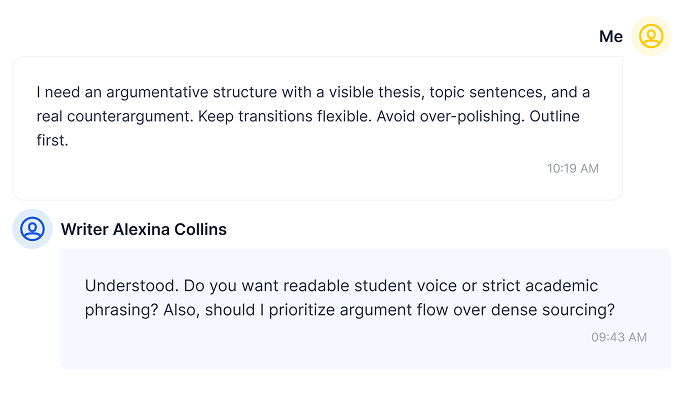
“I need an argumentative structure with a visible thesis, topic sentences, and a real counterargument. Keep transitions flexible. Avoid over-polishing. Outline first.”
The reply told me more than any rating:
“Understood. Do you want readable student voice or strict academic phrasing? Also, should I prioritize argument flow over dense sourcing?”
That question is my first proof element. It shows the writer is calibrating voice and academic expectations instead of guessing. I answered in a way that would protect a student later:
“Readable, but structured. If a sentence makes a strong claim, it must be supported. No grand conclusions.”
Then I added a second request that students forget to make on WriteAnyPapers:
“If possible, send a short outline and one sample paragraph before you write the full body. I want to catch tone issues early.”
My observation: this is where services usually reveal whether they behave like drafting partners or vending machines. WriteAnyPapers.com leaned toward collaboration.
WriteAnyPapers Timeline Table – What I Asked, What Happened, What Felt Off
Context before the timeline: I treated this order the way I treat a student’s early draft conference. I set checkpoints that force clarity. The point was not to “catch the writer making mistakes,” but to see whether the process can be guided in real time before a full draft hardens into something difficult to edit. When students get in trouble with services like WriteAnyPapers.com, it’s usually because they only react after delivery.
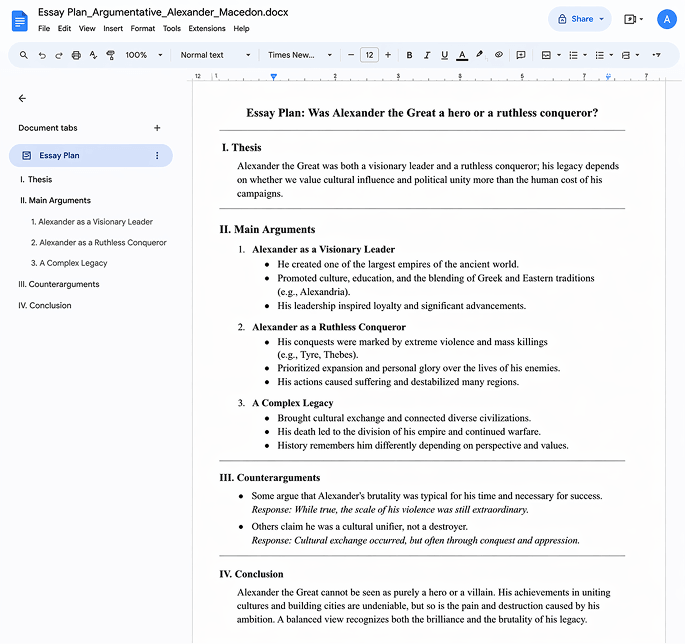
How to read the table: “What felt off” does not mean “bad.” In academic work, mild friction is often healthy. It shows where assumptions live, where tone drifts, or where a revision request is too vague to execute.
| Day | What I Asked | What Happened | What Felt Off (Or Telling) |
| Day 0 | Outline first + sample paragraph | Writer agreed and confirmed tone preferences | Good sign: negotiation happened before drafting, not after |
| Day 1 | Outline check for counterargument strength | Outline mirrored the requested structure | Counterargument looked “safe” at first; I flagged it immediately |
| Day 2 | “Make the counterargument harder to refute” | Writer asked whether new sources were allowed | Scope awareness: they didn’t pretend revisions are infinite magic |
| Day 3 | Midpoint check-in: “send the body skeleton” | Received a structured progression of points | Tone was readable, but one transition sounded too “professional” |
| Delivery | Final draft + keep it editable | Draft arrived coherent and not overly ornate | One paragraph made a strong claim with thin support; needed tightening |
| Revision | Reorder sections + soften conclusion | Edits applied without restarting the order | Vague requests were ignored; precise requests were implemented cleanly |
After the timeline: This is the most honest part of my WriteAnyPapers.com test. A decent draft was the result of three small negotiations rather than one perfect instruction. If you want a paper that survives scrutiny, you have to intervene early, outline, sample paragraph, skeleton, before the final version arrives. That is the only way the end product looks authentically yours.
Small Proof Moments Hidden Inside the Story
I’ll isolate a few observations that usually get buried in generic WriteAnyPapers reviews, because these are the things students actually need when instructors demand “process.”
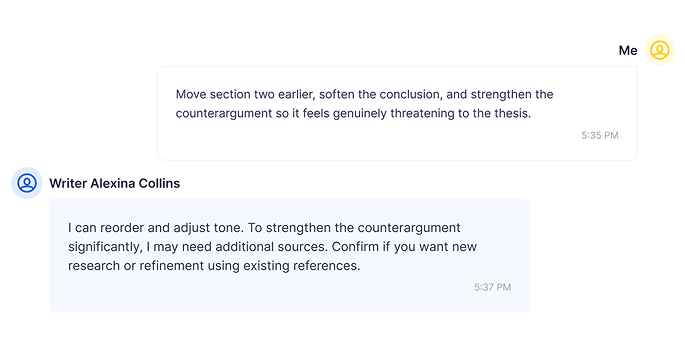
- The title page appeared before I even asked, and that is rare. It showed up as part of the deliverable without an awkward upsell moment.
- Formatting did not feel transactional. The draft arrived in a conventional academic layout instead of a messy text dump that requires paid cleanup.
- Bibliography behavior was integrated. References did not appear as an afterthought; they were structurally tied to claims.
My note: I notice these things because I’ve watched students lose points for formatting and citation structure even when their ideas are decent. A platform like WriteAnyPapers that makes structure automatic reduces a specific kind of academic damage.
Where The Writer Pushed Back – And That Was A Good Sign
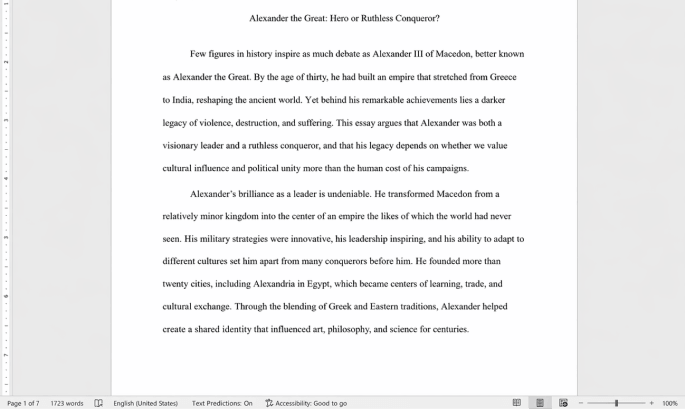
Here is the moment where the interaction on WriteAnyPapers.com stopped being polite and started being informative. I requested a stronger counterargument plus structural changes in one revision request, something students do when they panic:
“Move section two earlier, soften the conclusion, and strengthen the counterargument so it feels genuinely threatening to the thesis.”
The response was calm, but firm:
“I can reorder and adjust tone. To strengthen the counterargument significantly, I may need additional sources. Confirm if you want new research or refinement using existing references.”
This pushback is not a flaw. It is an honesty marker. Many services say “yes” to everything and then deliver cosmetic edits. Here, the writer clarified scope, which is exactly what a capable assistant would do.
I confirmed refinement using existing sources. The revision returned with better flow and a toned-down conclusion. The counterargument improved, though it still required my own tightening, which is frankly how academic writing normally works.
Pricing and Calculator Reality – Moved Here On Purpose
I intentionally did not start with pricing, because that is how SEO reviews begin. But after the writing interaction, pricing becomes more meaningful: you can evaluate whether the workflow you experienced on WriteAnyPapers.com matches the money you are paying.
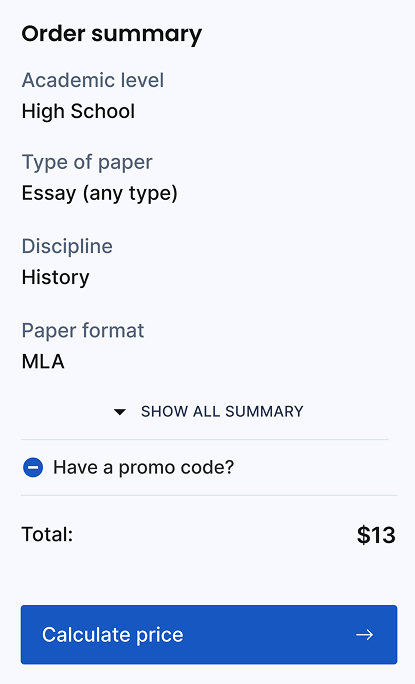
WriteAnyPapers.com presents starting prices by academic level. In the calculator, a common test configuration (High School, 1 page, about 275 words, 14-day deadline) displayed a total around $13. The key point is that the number behaved predictably as options changed.
- Deadline adjustments caused gradual shifts rather than sudden jumps.
- Academic level changes recalculated instantly and transparently.
- Nothing in the flow behaved like a surprise fee ambush.
My observation: students do not fear paying. They fear paying and then discovering the platform behaves differently than promised. Predictability is a form of trust, and WriteAnyPapers.com behaved predictably in my test.
Three Things I Expected To Fail – But Didn’t
- Pricing shift: I expected checkout totals on WriteAnyPapers.com to drift away from the calculator estimate. It didn’t behave that way in this scenario.
- Revision scope: I expected “free revisions” to mean shallow paraphrasing. Instead, the writer asked for scope confirmation and implemented structural edits when instructions were precise.
- Formatting inclusion: I expected formatting to be a hidden upsell. Instead, the draft arrived in a conventional academic format, with structural elements appearing without theatrics.
None of this guarantees excellence. It does indicate operational seriousness, something students can build on if they are willing to revise actively.
Would I Let My Own Students Use WriteAnyPapers.com
If a student asked me this in office hours, I would not answer with a moral lecture. I would answer with conditions.
- Condition one: treat WriteAnyPapers as a drafting tool, not a submission button. You still need to revise voice, verify sources, and tighten claims.
- Condition two: request process artifacts early on WriteAnyPapers.com, outline first, then a sample paragraph or skeleton. This reduces the risk of receiving a polished document that does not sound like you.
- Condition three: keep versions. If an instructor asks for drafting evidence, you should be able to show progression and explain edits you made yourself.
In my testing, WriteAnyPapers behaved less like a flashy marketplace and more like a procedural drafting environment: negotiation happened early, structural elements appeared without drama, and revisions were handled inside the same workflow instead of being treated as a separate product. That is not “safe” in an academic sense, nothing is, but it is more process-transparent than many services students stumble into under deadline pressure.
FAQ
1) If my instructor asks for a rough draft or planning notes, what should I request up front on WriteAnyPapers.com?
Ask for an outline first, then request a skeleton draft (topic sentences plus key citations) before the full prose. Also request two saved versions: Draft v1 and Draft v2 after revisions. That gives you a defensible progression without forcing anyone to fabricate a fake drafting history.
2) How do I prevent the draft from sounding “too perfect” or unlike my usual voice when I use WriteAnyPapers?
Tell the writer to keep sentences shorter, avoid idioms, and minimize overly polished transitions. Then do a final voice pass yourself: rewrite the introduction and conclusion, and replace a few high-gloss phrases with your natural phrasing. In my experience, voice mismatch shows up most clearly in the first and last paragraphs.
3) What is the fastest way to check whether the sources actually support the claims?
Pick three sentences with strong claims and trace each one to the exact cited source. If the source only loosely relates, soften the claim or replace the citation with a stronger one. This quick audit catches a common academic weakness: citations that are present but conceptually thin.
4) What should I do if I realize the argument direction is wrong halfway through?
Don’t request a full rewrite immediately. Ask for a revised outline first with the new thesis and a reorganized paragraph plan. Once the structure is correct, revisions become targeted rather than chaotic, and WriteAnyPapers writers respond better to that kind of bounded change.
5) How do I use revisions strategically without turning it into endless back-and-forth?
Bundle feedback into a numbered list with location cues: “Paragraph 3: tighten claim,” “Section 2: move earlier,” “Conclusion: remove new idea.” Writers respond better to specific, bounded tasks than to vague feedback such as “make it better” or “fix tone.”